Kiwi Olympics

My article in this week’s Insights newsletter. It is a #3, the third item in the newsletter which is always an attempt at humour. You can sign up to our weekly newsletter here.

Dear International Olympic Committee,

Please find attached our bid to host the 2036 Olympics Games in Wellington.

We noticed that at US$25 billion, Tokyo Olympics are the most expensive Games ever. That is a lot of sheep meat, as they say.

So forget unity and aspiration. The theme of the 2036 Olympic Games in Wellington will be fiscal responsibility.

Needless to say, our economic advisers are very excited about this theme. They have calculated that a fiscally responsible Games in 2036 will be “extremely efficient,” which means “wildly popular.”

Here is how we will cut costs.

First, we will run the 100 metres dash over 80 metres. To compensate, we will either make the track uphill or athletes will do the last bit twice. They won’t mind.

Instead of gold, silver and bronze medals, the medals will be tin, aluminium and tin with manure. We will make the ribbon out of number 8 wire because cliches are very cheap.

We think Tokyo was onto something by not letting anybody apart from athletes into the venues. We will save even more money by not having venues. We will broadcast everything via web cams. Spectators can watch on Youtube. Think of the emissions!

We also propose to remove two rings from the Olympics logo to save money on signage.

And no Games village. The athletes will be billeted.

As for mottos for the 2036 Games, we have some ideas. They include “Cheap as chips” and “Sweet as.” But we are leaning towards “Chur!” mainly because it has the fewest letters.

We are not going to lie to you. Hosting the Olympics in Wellington has risks.

For example, we cannot be sure the pool will have water or that you will be able to see the bottom. And let’s just say the water might have… obstacles. Does the term “Code Brown” mean anything to you?

The boat races will start in Wellington harbour. We just don’t know where they will finish. Depending on the wind, it could be Auckland, Christchurch or Chile.

Martial arts and shooting competitors will have dedicated facility thanks to a generous offer from the friendly team at the Mongrel Mob.

To commemorate the Wellington Olympics, the entire city will be declared heritage after the Games. Whichever parts were not already heritage, that is.

Finally, we promise to start the 2036 Games on time. Unless MIQ is still a thing in 2036 in which case all bets are off.

Yours etc.

Time to get real about emissions

It is nice to see others point out the consequences of an emissions cap. Thomas Lumley gets the logic of an ETS:

We’ve got a cap (more or less). One of the non-intuitive aspects of having a cap rather than a fixed price is that parallel efforts to reduce carbon emission don’t work the way you’d expect them to. If I replace my gas stove with an electric one, my kitchen will emit less carbon (modulo the impacts of making the new equipment).  If everyone did it, everyone’s kitchen would emit less carbon (again, ignoring the impacts of making the new equipment).  What would happen to NZ’s total carbon emissions? Nothing. We have a cap.  Less of the cap would go on carbon coupons for burning natural gas; more of it would be available for cars or trucks or coal-fired power stations.  The impact of our kitchen-renovation decisions would be cheaper emissions rights for other polluters, not lower emissions.

Well said, Thomas.

A commenter on Thomas’s post has some fairly standard objections to the argument:

First, the ETS was thoroughly undermined by the previous govt because the carbon price did not rise and companies were able to use dodgy offsets from overseas. If such a thorough undermining of a supposedly brilliant and effective self-regulating system could happen once, then it could happen again (with another change of govt).

This is solved by not opening the window to fraudulent credits. Or a commitment to make good on any credits which turn out to be fraudulent. Or both. That future governments might act in bad faith on emissions is an argument for the transparency of the sort an ETS provides.

Second, how high would the price of carbon have to go to shift people’s behaviour? And at that point is there the chance that you might get a general popular revolt that would undermine the political will to make the system to work as it should.

Good question. The Climate Change Commission says $50/tonne (p91). Basil Sharp et. al. say $85/tonne. In 2018, Concept Consulting, Motu and Public Policy Research said $76-$127/tonne. NZIER estimated far higher costs, also in 2018. None of this apart from NZIER looks scary with 29 years until the net zero deadline in 2050.

Anyway, non-ETS policies are far worse on a cost per tonne basis. Almost everybody acknowledges this. Cap and trade cuts at least cost. If your objection to the ETS is cost, you should be even more worried about other policies. As the joke goes, you do not have to outrun the bear to survive, you only have to outrun your colleague.

Officials have argued that the lack of transparency of non-ETS emissions policies buys enough cover to justify their higher costs. Except we have already had a public revolt mainly (though not entirely) against non-ETS emissions policies. I’d have thought is obvious that policies which add thousands of dollars to the cost of an imported car are going to be easy to spot. In any case, non-transparency is a non-argument for policies which have to work in the long run. Voters are going to it figure out eventually, and one might question the democratic merits of trickery.

Thirdly, there is the danger that emitters, rather than reducing emissions, basically rely on offsets. So, that will be great for increasing forestation, but it still might not change behaviour and reduce emissions

Which is just shifting the goal posts from emissions – you know, the thing that causes climate change – to changing behaviour and disrupting lives per se, which does not cause climate change. A tonne of emissions removed has exactly the same climate change benefit as a tonne reduced. From a climate change perspective, any distinction between reductions and removals is arbitrary. We should just do whatever combination of reductions and removals best helps the climate.

But try explaining to most environmentalists the idea that there is an emissions penalty that goes with arbitrarily insisting on reductions over removals, or domestic over offshore, or EVs over pretty much every other scalable way to avoid emissions. I cannot recall ever seeing an environmentalist say they are concerned we might lose 95% of the emissions benefits of a policy by insisting each tonne has to come from EVs and nothing else. The attitude seems to be who cares if we could have cut 20 times more emissions for the same cost?

I do. And when the rubber meets the road, so will voters. Time to get real.

Submission on the Natural and Built Environments bill

I wrote the submission by the New Zealand Initiative on the exposure draft of the government’s Natural and Built Environments bill, or “NBA.” This is the first of three bills that will replace the Resource Management Act. We do not have undiluted praise for the bill. I will post more on it soon.

For now, here is our conclusion:

The proposed arbitrary and potentially all-encompassing powers to be conferred on executive government are draconian, unconstitutional and utterly unjustified as a response to any identified problem to do with land use. The NBA proposes to give the current and future Ministers for the Environment the power to regulate everything – every aspect of how we live, work and play. The Natural and Built Environments Bill is unconscionable in a democracy

Read the submission here.

Forest fires and the power of emissions accounting

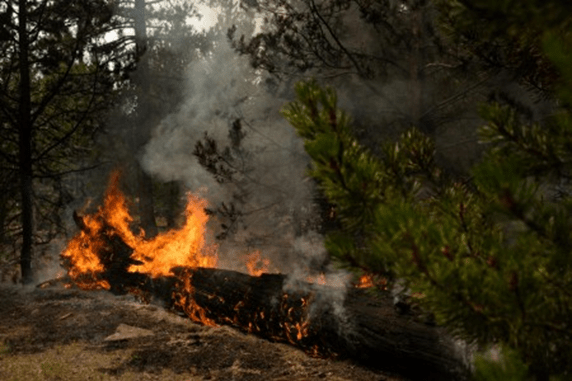
It seems forest fires on the west coast of the United States are threatening access to carbon offsets used by BP and Microsoft among others.

Source: Carbon News/InsideCLimateNews.org

Some have claimed forest fires mean the carbon captured in forests could be less than permanent. Here is the Climate Change Commission in their final report (p65):

Climate change exacerbates forest fires, strong winds, storms, droughts, pests and pathogens – so there are also risks associated with the permanence of using forestry to remove emissions from the atmosphere, as these emissions are released if the forest degrades or is destroyed.

But it is easy to make carbon removals by forests permanent even with forest fires. Simply oblige forest owners to report fires and make them responsible for re-capturing each tonne of carbon released into the air, either by replanting the forest or some other offset.

In practice, this is a matter of assigning accounting liability to the forest owner.

Measurement might be complicated in the detail, but the principle is simple: the forest owner is only rewarded for the emissions they capture.

Responsibility for the emissions component of the risk of forest fires should sit with the forest owner, on the principle that risk and control should sit in the same place.

The New Zealand ETS assigns responsibility for the emissions from forest fires to the forest owner. Good. My understanding is that after changes last year, a forest owner has four years to replant their forest after a fire. After that, the owner is assigned an ETS liability equal to the emissions released from the fire. That obligation means the owner must purchase and surrender emissions units back to the government, which effectively funds emissions reductions elsewhere in the economy.

I have used the example of forest fires to demonstrate how an emissions accounting system can make impermanent carbon stores permanent. All that is required is that emissions are measured, surrender obligations are enforced, and there is a system in place to keep track of obligations over time. These do not seem like difficult problems to solve. Where these requirements are met, as they appear to be in New Zealand (at least for the forests in the ETS), forest fires have no effect on overall emissions.

The same logic applies, or can be made to apply, to other problems like pestilence that affect carbon capture and storage of forests.

There does not even need to be a cap on overall emissions. It is enough to just make owners responsible for recapturing emissions or offsetting elsewhere to turn flammable forests into permanent carbon stores.

That is the power of emissions accounting.

So how did the experts at the Climate Change Commission fail to take liability rules into account, especially in their final report after their public consultation had almost certainly alerted them to the idea? How could the Commission not have noticed fires lead to obligations for owners and the consequences of those obligations for emissions?

Here is a presentation I gave on this in March to the Waikato Economics Forum.

“Urgent”

Carbon News reports:

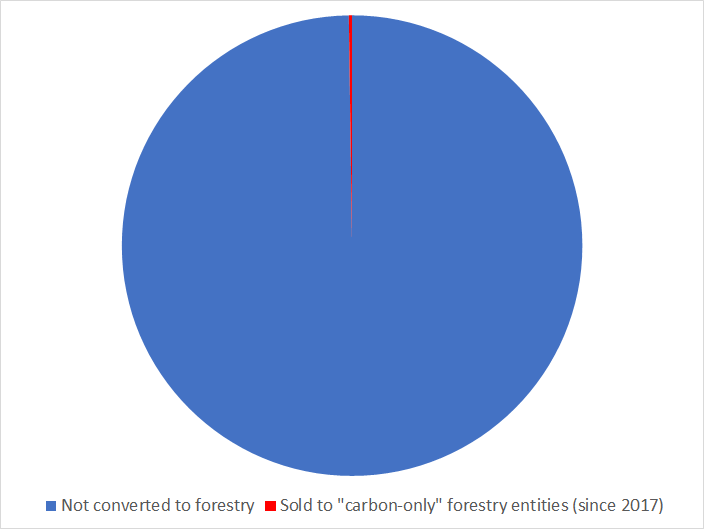
Research commissioned by Beef + Lamb New Zealand has found that about 26,550 hectares of farmland has been sold to “carbon-only” entities since 2017…

“Without urgent action, the sale of sheep and beef farms into forestry will only accelerate as the carbon price increases…”

According to Stats New Zealand there were about 11.7 million hectares of farmland in 2019, not counting the 1.9 million hectares of forests, which Stats also counts as farming.

I have plotted the 26,550 hectares of farmland sold to “carbon-only” entities since 2017. If you look closely, you can see the 99.8% of farmland that was not sold to such entities since 2017 in blue.

And just a reminder that the most significant opponent of forestry – probably the most cost effective and scalable technology we have to capture and store carbon dioxide and make progress towards our emissions targets – remains the Climate Change Commission.

Says it all, really

The Gisborne Herald reports:

Mr Robertson described the report of the independent Climate Change Commission as “the most important document of my political lifetime”.

Robertson is talking about a report that says we should spend 5-10 times more than necessary to cut emissions, threatens our emissions targets, is filled with untruths and rhetorical tricks, and all based on a strategy that does not make sense when the government has already capped emissions.

That’s the most important document in his political lifetime?

Well, it’s only important if people believe it. If you think the Climate Change Commission is independent, I have a bridge to sell you.

New Zealand emissions are falling

After peaking in 2006, net emissions of greenhouse gases from this country have fallen materially.

Since 2006:

  • Net emissions including agriculture are down 6.7%.
  • Net emissions including agriculture per capita are down 22.1%.

The gap between these two figures is population growth. Between 2006 and 2019, the population increased 20% from 4.2 million to 5.0 million. Total emissions is probably the relevant value for Paris 2030 but per capita is the more relevant value to the 2050 target of net zero emissions.

Gross emissions are responsible for 106% of the change in net emissions since 2006. Agriculture emissions peaked in 2014 and have fallen 1% since then.

Source: Greenhouse gas inventory 1990-2019, Ministry for the Environment

I suppose you think it is just a coincidence that New Zealand’s emissions began falling almost exactly when the Emissions Trading Scheme was launched?

Yes, it probably is a coincidence. The GFC landed in 2008 and after an early price spike the ETS did not deliver a carbon price in double figures until 2016. It is possible the fact there was an emissions price and the promise of higher future prices made a difference. But who knows?

The fall in net emissions after 2013, during a period of economic growth, is the more promising part of the trend line.

So there has been impressive progress on emissions.

There the good news ends. To reduce emissions to net zero by 2050 will require per capita emissions to fall at a higher rate, 48% faster than between 2006-2019. That is a big number, made bigger by the fact that the 22% reduction since 2006 was the low-hanging fruit.

It only gets more difficult from here.

What today’s carbon price can tell us about the next ETS auction

For two weeks now, New Zealand Unit (NZU) prices have stabilised at just below the ETS price cap of $50. This morning, NZUs are trading for $48.12.

It is possible that the price of NZUs on secondary markets will rise above the $50 cap. Were that to happen, it will be advance warning that the ETS price cap could be breached at the next NZU auction.

The ETS price cap only applies to the government’s auctions of NZUs. However, there nothing to prevent NZUs trading above $50 cap on secondary markets. The price of NZUs is simply the product of supply and demand. The price cap in auctions affects secondary markets because traders will not pay more than $50 for NZUs if they believe they can buy from the government at no more than $50 in the next auction.

Which is why an NZU price above $50 would be significant. It would be the market’s assessment that NZUs will not be available for $50 at the next auction. In other words, the clearing price at the next auction is expected to be above $50 and the price cap will be breached.

The government gives effect to the price cap in auctions by releasing extra NZUs from a reserve called the Cost Containment Reserve (CCR). The release of reserve units is triggered if the “interim clearing price” for the auction equals or exceeds the price cap.

If the CCR is triggered, the government will offer to sell 7 million NZUs from the reserve for $50 a piece. The release of these units defends the price cap.

But there are only a limited number of units to defend the cap. Once reserve units are exhausted, there will be no more to defend the cap. The clearing price for the auction will be free to rise above $50.

Although the government will offer to sell reserve units for $50, my understanding of the auction rules is that the government could end up receiving more than $50 for those units if there is sufficient demand.

Regulations provide a step-by-step procedure for working out the clearing price of ETS auctions.

An “interim clearing price” for an auction is calculated by filling offers to buy units in order from the highest price to lowest. The interim price is the price of the last buy offer that is partly or wholly filled.

If the interim price is equal to or above the “trigger price” – the $50 price cap – then the government will offer to sell reserve units at $50 a piece.

The market operator then continues down the list of buy offers until either all offers to buy at or above $50 are filled, or the CCR is exhausted. The final clearing price is the price of the last partly- or wholly-filled buy offer.

The final clearing price is the fair value of the units. All buyers pay the clearing price, rather than the price they offered.

There is nothing to prevent the final clearing price being more than $50, even with the release of the additional units from the reserve, if there is sufficient demand. Which is how the government could end up receiving more than $50 for reserve units even with a price cap of $50.

I have emailed the market operator to check my understanding of the rules is correct.

It is right that the government receives fair value for its reserve units. The alternative, a rule that forces the government to receive only $50 for reserve units no matter what, that would bring the risk of a speculative attack against the ETS – the opportunity to pay only $50 for units whose fair value is north of that amount.

Incidentally, a rough extrapolation of the price trend for NZUs over the last 12 months suggests we will reach an NZU price of $60 some time in February 2022. Yes, the CCR gets in the way by releasing more units. But a) the CCR is already priced in, and b) only 1.7 million units in the CCR are additional (the rest are in this year’s emissions budget but held back).

Why so angry?

After a recent article in the Herald (ungated version here) I received the following email:

I realise that your objective is to advance a right wing agenda rather than provide factual information, but I was sufficiently annoyed by your article that I have provided media with the attached more informative article, to help people understand the real issues.

The article from my correspondent (I will not name him) was mostly about how EVs are good and will become great in the near future. I suspect he is right.

But that completely misses the point of my Herald piece.

My point is that having capped emissions with the Emissions Trading Scheme (ETS), to then tax or subsidise vehicles or anything else already covered by the cap will make no difference to total emissions.

This has nothing to do with the merits of EVs. Of course EVs can reduce emissions. But the emissions benefits of EV subsidies must be zero under a binding emissions cap.

The question I want to consider here is why an argument against ineffective emissions policies should lead somebody who is worried about climate change to feel angry.

I do not know my correspondent. I assume he was not the only person annoyed by my article. For the purposes of this post, I will assume people who feel angry reading my article:

  1. Are worried about the climate change.
  2. Believe greenhouse gas emissions cause climate change, and
  3. Support policies and actions which lower emissions.

What could lead someone who holds those views to object to an argument that we should oppose emissions policies which do not lower emissions?

Before I try to answer this question, let me first say I do not usually spend time thinking about peoples’ motivations on policy matters. My focus is on the merits of policy. Here I make an exception because I want to reach people who are concerned about climate and who see me as an opponent. If I can understand why people get mad, I have a better chance of communicating effectively and, ultimately, helping.

So let the speculation on where the anger is coming from begin.

First, the objective (lower emissions) is bundled with specific actions. Support for action on climate is support for more EVs, more renewables, less coal and petrol. These actions go with the goal of lower emissions like peas and carrots. EVs always mean lower emissions. Coal always means higher emissions. And more is always better when it comes to favoured technologies; for disfavoured technologies, less. No exceptions.

This view does not fit well with reality. It is probably not obvious, for example, that using coal and natural gas plausibly makes it easier to reduce emissions, or that further investment in renewables beyond some unseen limit in our electricity system will make it harder to achieve our emissions targets. See the ICCC final report on electricity.

For anyone who sees action on climate and getting more EVs on roads as the same thing, any argument against EV subsidies is going to look a lot like an argument against cutting emissions per se.

Second, the only alternative to taxes, subsidies and regulations to lower emissions is to do nothing. Here is James Shaw (at 43:00) saying exactly that to Parliament’s Environment Committee at a recent appearance, for example, after being challenged on the effectiveness of policies.

Such a conclusion is surely natural for anyone who has not heard of the ETS, or who does not know that it caps emissions, or who does not see the cap as credible, or who does not understand how a cap will generally neutralise other policies.

Shaw is in none of those categories, by the way – it is his cap! He introduced the legislation which gave the ETS its hard emissions cap. The bill passed last year.

I suspect another driver of this “alternative is doing nothing” view may have something to do with the idea that human agency is a necessary part of lowering emissions. Sure, the ETS will have some effect, the thinking might go. Profit-maximising corporates will always respond to the incentives of a carbon price. But we will not succeed, the thinking may go, unless somebody decides how and where emissions come down. Many seem to believe prices alone cannot bite hard enough to shift behaviours; we need more than incentives to overcome consumers’ myopia.

Third, I wonder if people are quick to suspect trickery lies behind any question of emissions policies? Sure, this person says he wants lower emissions, but perhaps there is a hidden agenda, either a political agenda or opposition to action on climate.

Another possibility is that the response to my article is a “rally behind the flag” effect. The classic example of rallying behind the flag is America’s response to the attack on Pearl Harbour by Japan in 1941. Political accountability for the catastrophe was put to one side. The focus was squarely on the forward-looking question of winning the war.

I do not think flag-rallying explains much in climate. Bad emissions policies are not in the past – they are not sunk, as it were. Policies are very much in the here and now, or in the future. They can be changed. Those policies will determine success or failure in the war on emissions.

If anything, rallying behind the flag should encourage not deter (constructive) skepticism of policies. Yet many people do not welcome questions about whether emissions policies work. If rallying behind the flag means overlooking past mistakes to focus on the mission at hand, climate policies are not a good fit.

Whatever explains the anger towards my article, it probably does not help that I am one of the only people saying emissions policies should work. It is striking how, out of all the people who demand action on climate, almost nobody has any apparent interest in the performance of the government’s emissions policies.

Anyway, these are my guesses about the psychology behind the interesting conundrum of why well-meaning, intelligent people who want action to reduce emissions feel genuinely angry when they see someone pointing out where emissions policies might not work.

This anger has consequences. It will, and almost certainly has, suppressed questions at the government on the performance of its policies.

We now stand at a precipice. In the next few months the government could commit to policies that will cost percentages of GDP but will not lower emissions, not by a single tonne. If the current track continues, we will end up materially poorer while doing nothing to help future generations on climate.

Surely, there no political constituency for that outcome? Yet that is the path we are on. Almost nobody is asking the government this most basic question: how does your emissions strategy cut emissions?

That question helps protect future generations. So don’t be angry at the person asking it. Be angry about the answer.
A solution searching for a problem

John Cochrane may be grumpy but he is possibly my favourite living economist.

In this article he makes a number of great points about climate financial risk. Here are two:

The idea that climate change poses a threat to the financial system is absurd, not least because everyone already knows that global warming is happening

Climate regulatory risk is slightly more plausible. Environmental regulators could turn out to be so incompetent that they damage the economy to the point of creating a systemic run.

One hopes that officials working on climate financial regulation in New Zealand understand the significance of knowing what has already been priced, and that regulation has costs and risk and if sufficiently-poorly designed could be a greater threat than the underlying problem. Officials seem to find market failure in a lot of places; regulatory failure less so.

Cochrane concludes:

Climate change and financial stability are pressing problems. They require coherent, intelligent, scientifically valid policy responses, and promptly. But climate financial regulation will not help the climate, will further politicize central banks, and will destroy their precious independence, while forcing financial companies to devise absurdly fictitious climate-risk assessments will ruin financial regulation. The next crisis will come from some other source. And our climate-obsessed regulators will once again fail utterly to anticipate it – just as a decade’s worth of stress testers never considered the possibility of a pandemic.

Read the whole thing.

HT Jim Rose.