The best solution to the ETS price cap is to dump it

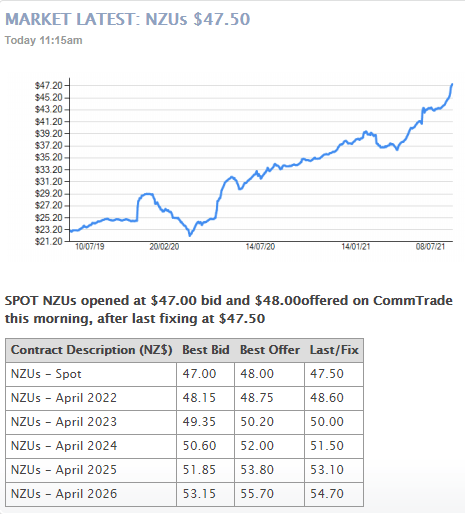
With prices turning vertical on the Emissions Trading Scheme (ETS) over the last two months, the government finds itself exposed to fiscal and reputation risks.

These risks do not come from the price increases per se, but from the way the price cap mechanism introduced to the ETS this year.

The price of carbon on the ETS now sits at $48, just $2 below the $50 price cap.

The cap could be breached at either of the next two auctions on 1 September and 1 December.
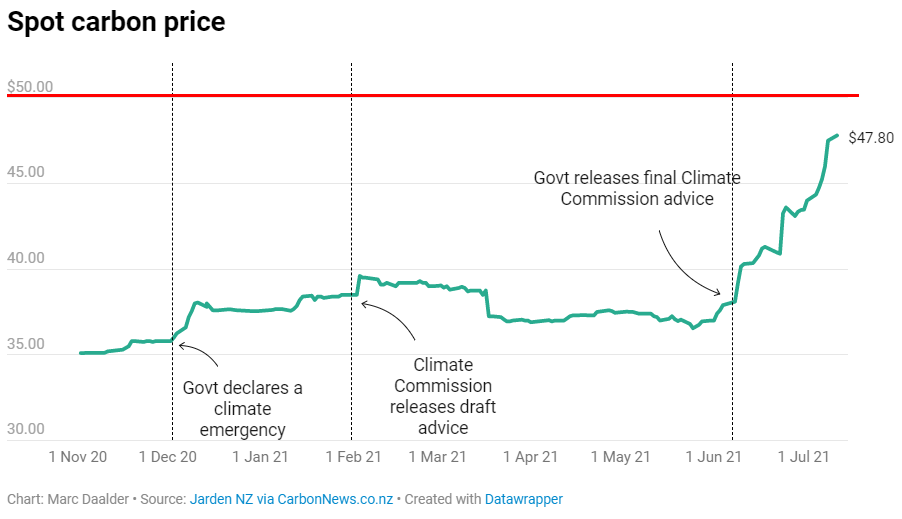
Source: Newsroom/Marc Daalder

According to Newsroom, Climate Change Minister James Shaw has ruled out raising the price cap.

The ETS has had a price cap for years. Before changes last year, the price cap was very simple.

The government gave effect to the cap with a standing offer to sell an unlimited number of emissions units at the fixed price.

For years, the price cap was $25. The government would sell any number of units to anyone willing to pay $25 for each unit.

Nobody was going to pay (much) above $25 for emissions units if they could buy from the government instead. Thus the government’s standing offer capped prices.

But price certainty came at the cost of quantity uncertainty. The problem with selling unlimited emissions units to enforce the price cap is that it left emissions uncapped. Every emissions unit sold to enforce the price cap meant extra emissions.

The ETS was a cap-and-trade system without a cap.

Changes to the ETS in 2020 fixed that problem. The changes retained a price cap, but put a limit on how many emissions units could be sold to defend the cap. This year that number is 7 million emissions units. Those units are held in a ringfenced pool called the Cost Containment Reserve, or CCR.

The advantage of this approach is that it gives the ETS a hard quantity cap.

But certainty on quantity makes the price cap soft. Once the units in the CCR are exhausted, there are no more units to defend the price cap. The price cap is then breached. Prices will be free to rise above the cap based on supply and demand until the reserve is refilled next year.

Rising ETS prices means there is a real possibility the new price cap is about to be breached in its first year of operation.

For anyone who is concerned about greenhouse gas emissions, the higher ETS price is unambiguously good news.

A rising carbon price will drive greener consumption by households and businesses. The ETS covers almost everything in the economy, the main exception being livestock. And the fact that the ETS price has risen so steeply in the last 12 months without much or any complaint is points in favour of its political viability.

But reaching and possibly breaching the new price cap so soon after its introduction will bring problems.

The first is the risk of a speculative attack on the price cap. If the market believes the fair price for units, even after the release of the seven million units from the CCR, sits north of $50, then there will be what amounts to a run on the bank.

A run would play out like this. The government sells its seven million reserve units for $50 a piece. The CCR is exhausted and prices rise above $50. Speculators then sell the units, cashing in on the difference between the market price and the $50 they paid for the units. Taxpayers take a hit. Treasury writes off the loss. Nobody comes out looking good.

A second set of risks arises from a rule introduced in last years reforms which says the government must ‘back’ some of the units it sells to defend the price cap.

Normally, selling extra emissions units means higher emissions. The idea of ‘backing’ units is to sanitise units sold from the reserve so that they do not raise emissions. In effect, the ‘backing’ rule says the government must offset the extra emissions of reserve units.

In principle, this is an elegant mechanism that rightly gives priority to credibility of the emissions cap in the ETS.

But it takes systems and processes to do the job properly. It is not clear the government has had time to put the systems in place to properly offset emissions.

The key issue here is credibility. Offsetting emissions is not particularly difficult in itself. Trees capture and store known amounts of carbon per hectare. It is possible to buy and shred emissions units from any of the ~27 other ETSs around the world. Or to partner with organisations that specialise in offsets. And so on.

But the offsets have to credible in the eyes of the government’s supporters. Many environmentalists do not like the idea of writing cheques to cover our carbon footprint. They worry about a repeat of the Ukrainian credits scandal from the first half of the 2010s. They do not like planting trees to offset gross emissions.

At stake is the ETS itself. The offsets are defending the ETS cap. That is the whole ballgame. If the offsets are not credible, then the credibility of the cap and the ETS itself could come into question.

So what are the government’s options and what will it take to manage the credibility question?

The government could plant trees on Crown land. Those trees must stay outside the ETS permanently so that the carbon captured and stored by the trees does not lead to new emissions units being issued. Provided that is the case, the trees will genuinely offset the extra emissions from the ETS brought about by the extra units from the reserve.

That seems simple enough. But there must be systems in place to keep track of what carbon capture is additional and what is not. The trees must remain outside the ETS to be a genuine offset. If they were ever to come into the ETS any time in the next 30 years, there would need to be accounting in place to trigger additional offsetting elsewhere. Then there is the question of what happens after the trees are harvested – whether they are replanted or not. The government needs processes in place for any promise it has offset emissions to be believed.

Alternatively, the government could look offshore. The European ETS is the world’s largest carbon market. The government could buy and then shred EU emissions units. That would credibly lower global emissions, meeting the backing rule.

The problem is emissions units from the EU are trading for nearly double the cost of units here, about NZ$92. Using EU units to back units here could result in a loss of more than $60 million per year at current prices. That loss could raise credibility problems of its own.

The government could consider more affordable emissions units from ETSs in other countries.

But that would raise the question of how the government provides assurance that the emissions units from those ETSs are real, that the government in the source country will not simply print more units in the future making the units we bought worthless.

These are hard problems that will take time to solve. Even if the government goes with domestic solutions, it does not seem to have any way to demonstrate the emissions reductions are real and permanent.

There is no discredit to the government for the awkward position it finds itself in. Few if any could have foreseen the steep increases in the ETS price. We have hit the ETS price cap far sooner than anybody probably thought.

But rules are rules and the government may have to find a solution to the backing problem quickly.

Perhaps the simplest solution is to get rid of the price cap. It is not necessary, and in any case it is a chimera: little more than a stop gap measure. If the fair price for emissions units is above the cap, the market will have no trouble blasting through the price cap.

The ETS has well-established spot and forward markets that give businesses and their customers ways to manage their exposure to fluctuating carbon prices – exactly what the price cap is meant to do.

The domestic ETS price has to be managed – no two ways about that – while maintaining a credible track to our emissions targets. The way to do that is use international offsets as a relief valve, accessing them as required to stay on track to our targets while keeping the domestic carbon price aligned with our trading partners (or whatever principle the government of the day decides appropriate).

Using international offsets in this way requires us to be organised about that access. We should be seeing an effort to put in place the systems and checks and balances that gives the current and future governments the option to go offshore when necessary, with the assurance, of course, that every international unit we trade or project we fund is authentic.

The current strategy combines a hard domestic emissions cap with international isolation. This has predictably led to price volatility in the ETS. We need to be smarter than this.

Going offshore does not mean doing nothing here. It means being prepared to open the door to offshore when necessary to stabilise prices here. Going offshore to cover 100% of our emissions reductions is too much. But 0% is too little.

Wear it with pride, New Zealand

Carbon News ($) reports New Zealand is not using climate change policies to manage public health.

Public health is desirable. So it is very much a good thing that we have public health specialists who know what they are doing when it comes to public health how to deliver public health.

Making climate scientists and climate policy makers responsible for public health seems like a good way to get neither public health or lower emissions. The present lot are having enough trouble just with emissions.

I like living in a country that scores zero on bad policy ideas, in this case conflating the technical problem of reducing of greenhouse gas emissions with public health outcomes.

The government deserves kudos for scoring badly on a ludicrous yardstick for climate policy.

Take the shorter path to success on climate

An emissions cap massively simplifies the problem of reducing greenhouse gases.

With an emissions cap, burning coal to keep the lights on in a dry year, for example, does not raise emissions. By definition, a cap means that for every tonne of emissions that leaves the generator’s smokestack, there must be one less tonne of emissions somewhere else in the economy. Getting to our emissions targets is a matter of reducing the emissions cap in line with those targets. James Shaw has aptly called this a “sinking lid”.

The Emissions Trading Scheme (ETS) caps emissions and the cap is falling over time in line with our emissions targets.

But good luck to any executive who says their company is fully meeting its responsibilities to reduce emissions thanks to the ETS cap. That line is simply not going to work.

That is because few people have heard of the ETS. Many who know about it don’t believe it really caps emissions. And although the ETS looks good on paper, right now we have little more than anecdote to show it is working in this country.

I expect the NZ ETS will prove to be highly effective, in line with findings from studies of cap-and-trade systems in other countries.

For the sake of argument, put to one side for now the important question of ETS effectiveness.

Consider two paths to net zero emissions in 2050:

  • Our current path, which has an ETS cap that is effective but not credible* combined with a welter of policies which give ministers and officials control over large parts of the economy, or
  • An alternative path, which has an ETS cap that is effective and credible. There are supporting policies but they stop well short of the sweeping controls in the current path.

What is the shorter path to success on climate? Is it to create a vast bureaucracy which has control over everything that produces emissions? Or is the shorter path to solve the ETS’s credibility problem?

I do not think improving the ETS’s credibility will be easy. But it is easier than the alternative.

I think the ETS’s credibility problem can be solved in four parts:

  • Strengthen the ETS to cover more emissions more robustly.
  • Introduce systems to test and demonstrate the ETS is working.
  • Credible protections for households and businesses against shocks in the carbon price, and
  • A carbon dividend to every household.

The key thing is to establish in the minds of enough voters that the government already has a system for reducing emissions, and that system makes other policies like a ute tax or a new bridge in Auckland not just unnecessary but worse than useless.

*It is important to note that I use the word ‘credible’ here in a particular way: I mean credible in the eyes of citizens. A $48 NZU price suggests the ETS is highly credible in the more usual sense that it has support in Parliament, that support is expected to endure, and the rights embedded in emissions units are regarded as secure.

The Climate Change Commission is an activist body

New Zealand could have gotten a Climate Change Commission that is rational and hard-nosed about the problem it is there to solve. Emissions cause climate change. We need lower emissions. Period.

Instead, we have been lumped with an activist Commission.

Its agenda is to transform the economy. And not just any transformation. The Commission wants more EVs, more solar and wind, fewer cows, less gas, and no coal. The Commission thinks lower net emissions should mostly mean lower gross emissions.

This prescription might as well have been written by Greenpeace. This Commission’s plan does not fall out of solving for effectiveness. Its preferred technologies do not give us the best chance of reaching our targets. No, the Commission’s plan is all about politics.

The Commission expressly rejects a least cost approach to reducing emissions. Under its plan, will pay vastly more than necessary to achieve our emissions targets. The Commission’s analysis shows we could get to net zero emissions with existing policies and a carbon price of $50 per tonne. Under the Commission’s plan, however, we will pay somewhere between $250 per tonne and more than $500 per tonne of carbon.

Those extra costs pay for the privilege of reducing greenhouse gas emissions via the particular channels preferred by the Commission, rather than what is most effective. That difference – between a least cost approach versus the Commission’s plan – has nothing to do with emissions or climate change. Emissions come down by about the same amount either way. The extra cost for the Commission’s plan is solely about reshaping society to the Commission’s preferred vision.

The huge added cost of the Commission’s plan means it is pursuing its vision vision at the expense of our emissions targets. Making our ambitious targets up to ten times more expensive threatens the successful delivery of those targets. That is a fundamental problem for a Climate Change Commission whose statutory objective is mitigation. It has made the mistake of pursuing non-emissions objectives at the expense of core business.

That is one reason why I believe the Climate Change Commission is an activist body.

ETS going vertical

From Carbon News ($), the carbon price on the ETS is going vertical, up 27% this year and fast approaching the $50 price cap in the ETS.

Eric Crampton and I recorded a podcast yesterday on the consequences of hitting the ETS price cap. I would expect to see the government raise the cap to $70 before the next auction of NZUs on 1 September.

Reforms to the ETS last mean each NZU sold by the government at the price cap has to be “backed,” which means for each unit sold at the price cap the government takes an action so that overall emissions do not rise. One way to sanitise units is to buy emissions units on a credible scheme like the EU ETS and shred them so nobody else can use them.

The problem is the government has not put in place the systems it needs to open up access to other markets. To be fair, that raises a complicated set of problems that go well beyond just the funding and machinery to give effect to an offshore transaction. And officials are incredibly busy on other things right now.

However, until the government has the systems and agreements in place to back the units it sells at the price cap, it is hard to see how the ETS price cap is credible: each time NZU prices go near the price cap, the government appears to have only limited options besides raising the price cap. Which rather defeats the purpose of having a price cap at all.

De-commission the Climate Change Commission

Tim Hazeldine writes ($) in the Herald today on how the Climate Change Commission has gone so far off-target. It is hard to excerpt, the whole article is excellent.

Our climate change policy should be solely about climate change. “You can’t kill two birds with one stone” is a cliche but it is not trite. It is true and important in almost every policy context. Yet the Commission considers it should in future “consider broader well-being factors, like eradicating poverty, safeguarding food security and addressing other environmental outcomes”. Wrong, wrong, wrong and wrong.

Exactly. It is not that those other outcomes are undesirable. But insisting emissions policies also solve those other problems puts our emissions targets at risk. Allowing other objectives into the decision making carries a huge emissions penalty. Second-best emissions policies have roughly no effect on emissions.

It is farmers, other businesses, entrepreneurs, innovators, inventors, scientists, workers, and, not least, households – the whole team of five million – who will get the job done, and at the lowest cost, so long as the overall cap set by the Emissions Trading Scheme (or through a carbon tax) is secure.

Also mostly pointless, are the multitude of policy recommendations that pour forth from the report. If the real decision-makers in the economy (i.e. all those listed above) are getting the correct price signal from the ETS, then there is generally no justification for further government intervention. What should be done will be done… The main exception will be in the provision of what economists call “public goods” – in particular research results

A binding ETS cap does not mean doing nothing else. It means being smarter about where to point other policies, targeting then in places the ETS does not reach or might not reach adequately. Where possible, use cost-benefit analysis to check policies are cutting emissions at a high-enough rate to justify their cost, taking proper account of the effects of the ETS. I say “where possible” because research is something that cost-benefit analysis may not be much help. But fill your boots on feebate and harbour crossings.

Just one of the [Commission’s] 1000 technical references is a well-published economics article. This, by the way, rates subsidising electric vehicles as the highest-cost of all known climate policies.

An indictment of the Commission. Naturally, having shown EVs underperform other technologies with the one piece of economic evidence they cite, the Commission recommends accelerating the uptake of EVs.

So, what to do? The Climate Change Commission has, in just a few months, seriously outgrown its boots. The Government should step in, and with polite thanks for their efforts, de-commission the commission. It should then persuade a super-smart mid-career research-grade Kiwi economist – tough-minded but humble (they do exist) – to take the reins of a slimmed-down secretariat.

This is a pretty robust conclusion. However, the Climate Change Commission arguably exceeded its legislated mandate in its first report, and its emissions reduction plan threatens our emissions targets. Those two problems are serious enough to fully justify Hazeldine’s conclusion.

We still do not know how the government’s emissions strategy reduces emissions

Carbon News recently interviewed James Shaw ($), the Minister for the Environment. The interview is excellent throughout, but it opened with a particularly good question:

One of the criticisms of the recently announced feebate scheme was that you could have achieved the same result by simply reducing the ETS cap by the amount of carbon emissions the policy is expected to save. What’s your response to that?

After talking about feebate, Shaw eventually gives his answer for not just reducing the ETS cap:

There’s a couple of things there. The ETS doesn’t cover all the economy. It doesn’t cover all emissions. Second of all, the cap is a sinking lid. So, what they’re talking about is something called the ‘waterbed effect’. If you cut emissions in one area and that takes things below the cap then it allows others to pollute more in the meantime.

But if you’re successfully lowering the cap every time then you minimise that effect because you’re saying, ‘Yes we’re taking emissions out here with the feebate and also with the ETS and then next time we set an emissions budget it will take account of the fact that emissions are lower.’

The way it works is you’ve got your 2050 target which is sort of long term. Then you’ve got your three five yearly budgets and each one is smaller than the one before. Every five years, at the start of each budget period, if circumstances dramatically change since you set the budget five years earlier, you can adjust at that time and say, ‘hey look things have moved far quicker or in unexpected ways we can adjust the budget to take account of that emissions budget.’

In a nutshell, Shaw says he can link the policy with the cap: for every tonne taken by the policy, the cap can be reduced by one tonne.

But notice Shaw did not answer the question: why not just reduce the cap without the policy?

If the ETS cap is binding – which means the cap is low enough to force emissions below what they would otherwise be – then emissions from the parts of the economy covered by the ETS will be solely determined by the cap (provided the government keeps enforcing the ETS). You can only cap emissions once.

Whether the cap is set according to policy outcomes, or based on a straight line to emissions targets, or set by rolling dice, whatever, a binding cap decides overall emissions.

Shaw is right that reducing the cap in line with policy outcomes from feebate reduces emissions. But all of the reduction is due to reducing the ETS cap. None of the reduction in emissions comes from the policy. If the ETS cap is binding, all a policy working within that cap can do is change where emission come down, and the cost. But not overall emissions.

The problem with Shaw’s strategy of linking the ETS cap with individual policies is to pre-empt discovery of how and where emissions can be reduced most cost-effectively. That is what an ETS does: for any given cap, the ETS raises the carbon price to however high is necessary to bring emissions down to within the cap. People who can reduce greenhouse gas emissions for a cost that is less than the carbon price will reduce, everyone else will pay the carbon price because for them that is cheaper than cutting emissions. Emissions come down from the least-cost sources first.

Linking the cap with feebate forces emissions to come down through a particular channel: people switching from combustion vehicles to EVs.

The alternative is to reduce the cap without the policy. Emissions come down via whatever channels are the most cost-effective. That is almost certainly not going to be EVs, for now.

The penalty for linking the ETS cap with policies is substantial: right now, the ETS can reduce or remove a tonne of emission for $43. Government policies regularly spend over $1,000 to achieve the same result. What, Minister, is the benefit those policies bring that could justify their huge cost?

If ETS+other policies reduces emissions by the same amount as the ETS alone, then it is not clear how the government’s emissions strategy cuts emissions. (The exceptions are policies outside the ETS cap – agriculture or international travel.)

Overriding the ETS comes with a substantial cost penalty. We are not talking 5% or 10%. The penalty appears closer to 1,000%. What then is the case for doing other policies?

What makes the question of why not just do ETS so important is that it goes to the government’s whole emissions strategy. For as long as that question goes unanswered, nearly every time ministers announce a new emissions policy they have no basis for saying their policy cuts emissions (unless it concerns livestock or 777s). Not the feebate scheme. Not the cycleway across Auckland harbour. Not the boiler replacement scheme. Not new LEDs in Parliament.

Policies which raise costs for no effect on overall emissions are worse than useless. They make it harder to get to our emissions targets, effectively taking us away from net zero emissions.

First post

Two years ago, I wrote a report about electricity. The report was called Switched On!, a title so bland even the exclamation mark could not save it. I will always regret not going with two exclamation points.

The report opened with the story of Germany’s energy policy. Nearly two years later, this story is the one that has stayed with me because it suggests the only limit on pure waste some areas of public policy may be bankruptcy.

Germany’s energy policy is called Energiewende. It launched in 2010 with a goal to replace Germany’s coal-fired electricity with solar and wind generation. Germany committed over €500 billion to produce first a boom in solar and a second boom in wind turbines.

The scale was extraordinary. In 2013, nearly half the world’s installed solar capacity was in Germany. Further investment in transmission of up to €1 trillion was necessary to cope with intermittency of solar and wind, and because much of the new generation was located a long way from urban centres.

All told, the policy will cost every German household between €12,000 and €37,000. That is the main reason why households in Germany pay the among the highest electricity prices in the world.

But Germany is doing its bit to save the environment, right? No. Emissions from Germany’s electricity sector have been static for the last ten years. Brown coal remains the largest source of electricity generation. Germany has retired some of its nuclear fleet, which has forced more of its emissions-heavy coal stations to remain open. Nevertheless, Germany’s attempt to lower emissions using solar and wind as a replacement for coal and nuclear has delivered at best only a marginal improvement in emissions.

What disturbs me about Germany’s experience is that it was predictable. The right person could have forecast the results of Energiewende in Excel. The huge cost of the programme should have led to analysis which steered policy makers in another direction for emissions reductions. Yet somehow the usual feedbacks did not apply when they were most needed.

Each of the following should have sunk Energiewende:

  • Germany receives the fourth lowest number of sunshine hours of any country (and solar produces almost no energy on cloudy days)
  • The same solar panels built in Spain would have produced three times more energy
  • Germany has access to only limited energy storage capacity (e.g. hydro lakes and pumped hydro), so intermittent solar and wind could not possibly replace baseload nuclear and coal
  • Coal plants can take more than a week to go from a cold start to full capacity. This meant that even when solar and wind were generating electricity, coal stations had to keep running in the background, ready to step in when solar and wind generation fell away.

Worse, with the failure of Energiewende now clear and with households in Germany paying among the highest electricity prices in the world, the policy is still popular. Somehow, the fact that the policy didn’t work does not count against it in public opinion.

There is value in analysis before the political commitment to a policy. After that point, analysis will not be enough to change direction, at least until a new government is elected. There was no way Chancellor Merkel was going to back off Energiewende after she had doubled down on the policy the day following the Fukushima event in Japan in 2011.

One of the goals for this blog is to be an early warning. I want to offer ways into problems that might not otherwise have been considered. The goal is to be constructive, which I will not always achieve in the current environment.

Another goal for the blog is as error correction. Much as I dislike mistakes, I will make them. They will be honest mistakes, always: there is nothing to be gained from defending a position that defies reason or evidence. I will post corrections as soon as I become aware of an error, and be transparent about it.

I want to hear other points of view, and find new authors, new reading and new ideas. And I want to write better by writing a lot.

On content, I will cover things I work on including climate policy, energy, and RMA. Some crypto. And maybe a few thoughts on space, rugby and cricket.

Welcome along!!